






3D Printing Revolutionizes the Aviation Industry
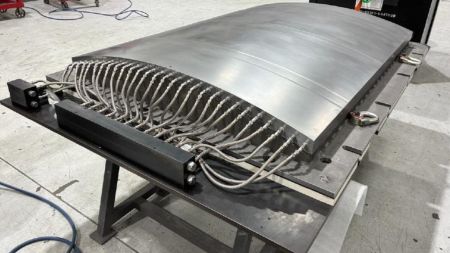
The use of 3D printing technologies in aviation enables the production of lighter aircraft parts and reduces manufacturing costs.
The aviation industry is facing a paradigm shift driven by the use of 3D printing technologies, particularly through the process of Wire Arc Additive Manufacturing (WAAM). This innovative technique enables the production of aircraft parts that are not only lighter but also more cost-effective. Traditional methods for manufacturing molds are often time-consuming and expensive, which affects production efficiency.
WAAM uses a welding wire that is applied layer by layer to create complex geometries. This method offers the advantage of high material utilization while significantly reducing production times. By minimizing material waste, it not only protects the environment but also enhances the cost-effectiveness of production.
Advantages of 3D Printing in Aviation
A key advantage of 3D printing is the ability to produce customized parts that are precisely tailored to the specific requirements of an aircraft. This leads to better performance and efficiency of the airplanes. Furthermore, the use of 3D printing can also lower inventory costs, as fewer parts need to be prefabricated and stored.
However, the implementation of WAAM in the aviation industry requires precise planning and a deep understanding of material properties. Engineers must ensure that the printed parts meet the stringent safety standards of aviation. This means that extensive testing and validation are necessary to guarantee the quality and reliability of the parts.
Another aspect driving the adoption of 3D printing technologies in aviation is the increasing demand for lighter aircraft. Lighter airplanes consume less fuel, which not only reduces operating costs but also lowers CO2 emissions. The aviation industry is under pressure to minimize its environmental impact, and 3D printing offers a promising solution.
Current Developments and Outlook
Several companies in the aviation industry have already begun integrating WAAM into their production processes. These companies report positive results regarding cost reduction and production speed. The technology is continuously being developed to enable even more complex and high-performance parts.
The future of 3D printing in aviation looks promising. With the ongoing development of materials and printing technologies, it is expected that more and more aircraft parts will be manufactured through 3D printing in the near future. This could not only revolutionize production methods but also sustainably change the entire industry.
The aviation industry is increasingly investing in research and development to further exploit the possibilities of 3D printing. The combination of innovative technologies and a growing awareness of sustainability could lead to 3D printing playing a central role in the future of aviation.
Current studies show that the market for 3D-printed aircraft parts will grow significantly in the coming years as more and more companies recognize and utilize the benefits of this technology.
Ähnliche Artikel

Total War: Shogun 2 DLCs as Gifts for Players
Owners of Total War: Shogun 2 receive the Legacy DLCs for free and save 75% on the new Complete Edition....

DJI presents SDR Transmission 2 for wireless 4K transmission
DJI has introduced the SDR Transmission 2, a new video transmission system that transmits DCI-4K60 with 10-bit HDR....

Digital Wallet "d-you" Launches in 2027
Digital Minister Karsten Wildberger announces the digital wallet "d-you," which will be available starting January 2027....

Hypertune: New Software for Gaming PCs
Hypertune offers automatic tuning for gaming PCs to enhance gaming performance. The software optimizes CPU, GPU, and Win...

comment Kommentare (0)
Noch keine Kommentare. Schreiben Sie den ersten!
Kommentar hinterlassen