



Souveraineté des données : clé de l'utilisation de l'IA en Allemagne
L'intelligence artificielle prend de l'importance dans les entreprises allemandes. La souveraineté des données devient le critère décisif pour l'utilisation de solutions IA locales.
En 2026, l'intelligence artificielle (IA) est considérée comme extrêmement importante dans les entreprises allemandes. Selon l'étude de Bitkom "Intelligence Artificielle en Allemagne", 81 % des entreprises considèrent l'IA comme importante. L'accent s'est de plus en plus déplacé vers la souveraineté des données, en particulier pour les entreprises de taille intermédiaire. Celles-ci ne se posent plus la question de savoir si elles doivent utiliser l'IA, mais plutôt où et comment elles vont mettre en œuvre ces technologies.
Un avantage central des applications IA locales est la pleine souveraineté des données. Lorsque des algorithmes critiques pour l'entreprise ou des données sensibles des clients sont traités par des fournisseurs externes, des risques imprévisibles apparaissent. Une étude récente d'IONOS et de YouGov du printemps 2026 montre que 53 % des petites et moyennes entreprises (PME) allemandes interrogées expriment une profonde méfiance envers les fournisseurs d'outils IA non européens. Ces préoccupations ont conduit à ce que la souveraineté des données devienne un critère d'achat économique décisif.
Tendance croissante vers des solutions IA locales
L'étude IONOS "Le Mittelstand allemand veut de l'IA, mais se méfie des fournisseurs d'outre-mer" prouve que 36 % des entreprises préfèrent un fournisseur de solutions IA d'Allemagne ou d'Europe. Dans l'étude de Bitkom, même 93 % des entreprises expriment le souhait de considérer des fournisseurs locaux avant de choisir des solutions IA pour leur utilisation en entreprise. Ces chiffres illustrent le besoin clair de solutions IA locales qui répondent aux exigences spécifiques et aux cadres juridiques en Allemagne.
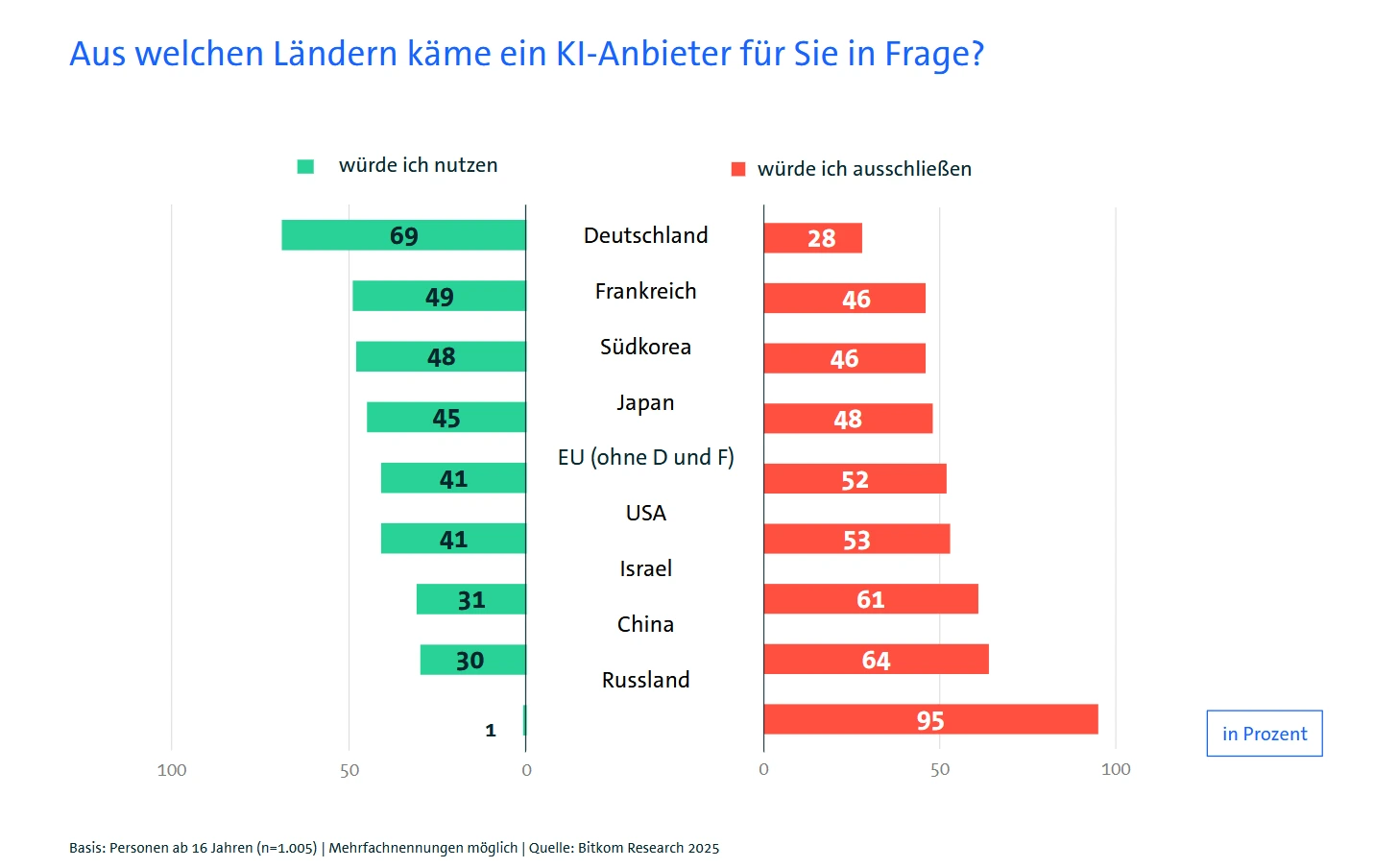
De plus, l'étude de Bitkom montre que 69 % de la population préfère un fournisseur IA d'Allemagne. Cette préférence se reflète également dans les décisions des entreprises, qui misent de plus en plus sur des fournisseurs locaux pour faire face aux défis de la souveraineté des données et aux exigences strictes européennes. L'acceptation des solutions locales augmente, car les entreprises souhaitent garder le contrôle sur leurs données.
Autonomie technologique et efficacité des coûts
Dépendre de fournisseurs externes comporte des risques qui peuvent conduire les entreprises dans un piège dangereux de verrouillage fournisseur. Les augmentations de prix, les annonces de fin de modèle ou les changements soudains des réglementations sur la protection des données à l'étranger peuvent gravement compromettre l'exploitation. Les solutions IA locales, qui reposent souvent sur des modèles open-source hautement spécialisés, offrent aux entreprises une autonomie technologique et une indépendance.
Un autre avantage des systèmes IA locaux est l'efficacité des coûts mesurable. Au lieu de frais de jetons imprévisibles et évolutifs, les entreprises investissent une fois pour toutes dans du matériel dédié ou des structures de serveurs privés. Cela permet une planification à long terme des coûts d'exploitation et protège contre des charges financières soudaines imposées par des fournisseurs externes.
Le développement vers des solutions IA locales n'est pas seulement une réaction à la méfiance envers les fournisseurs étrangers, mais aussi une décision stratégique pour sécuriser leur propre compétitivité. Les entreprises qui misent sur l'IA locale peuvent optimiser leurs processus tout en garantissant le respect des strictes réglementations européennes sur la protection des données.
L'étude de Bitkom et l'étude d'IONOS montrent que la demande de solutions IA locales en Allemagne continue de croître. Les entreprises reconnaissent de plus en plus les avantages liés à l'utilisation de l'IA provenant de sources nationales et optent pour des solutions qui répondent à leurs exigences spécifiques.
Ähnliche Artikel

Claude von Anthropic introduit des filigranes numériques
Le chatbot IA Claude d'Anthropic marquera désormais les textes avec des filigranes numériques pour identifier leur prove...

Des virus conçus par IA combattent les colibacilles
Des chercheurs américains ont développé des virus soutenus par l'IA qui infectent et tuent spécifiquement les colibacill...
Application ChatGPT pour Linux publiée
L'application officielle ChatGPT pour Linux est maintenant disponible, mais avec des limitations....

85 pour cent des projets d'IA échouent – Causes et solutions
Une nouvelle enquête montre que 85 pour cent des projets d'IA dans les entreprises échouent. La technologie n'est pas en...

comment Kommentare (0)
Noch keine Kommentare. Schreiben Sie den ersten!
Kommentar hinterlassen