


India's first private launch vehicle Vikram-1 launched
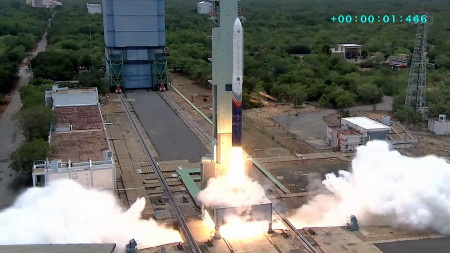
India has successfully launched its first private launch vehicle Vikram-1, marking its entry into the realm of private spaceflight.
On July 20, 2026, India successfully launched the Vikram-1, its first privately developed launch vehicle into space. This milestone marks India's entry into the exclusive group of countries that have the capability to develop and launch private rockets. The mission, named "Aagman," aims to further diversify the Indian space industry and integrate private companies into the space sector.
The Vikram-1 was developed by the Indian company Agnikul Cosmos, which was founded in 2017. The rocket is specifically designed for launching small satellites and offers a cost-effective solution for customers looking to enter the space sector. With a height of about 20 meters and a weight of 1500 kilograms, the Vikram-1 is capable of carrying payloads of up to 300 kilograms into low Earth orbit.
Technical Features of the Vikram-1
The Vikram-1 is equipped with an innovative propulsion system based on hybrid fuel. This system allows for precise control during launch and orbital maneuvers. The rocket consists of three main stages that are ignited sequentially to maximize efficiency and performance during launch. The first stage uses solid fuel, while the second and third stages rely on liquid fuel, providing greater flexibility and adaptability for various missions.
The "Aagman" mission has not only technical significance but also an economic dimension. With the development of the Vikram-1, India is expected to play a significant role in the global market for small satellite launches. The market for small satellites is growing rapidly, and the Vikram-1 positions itself as a competitive option for international customers seeking cost-effective launch solutions.
Another important aspect of the mission is the promotion of innovation and entrepreneurship in India. The Indian government has taken initiatives in recent years to support private companies in the space sector. This includes financial incentives, technical support, and access to infrastructure that enables start-ups to develop and test their technologies.
The Importance for the Indian Space Industry
The successful launch of the Vikram-1 is a significant step for the Indian space industry, which has traditionally been dominated by the Indian Space Research Organisation (ISRO). With the introduction of private launch vehicles, competition in the sector is expected to increase, potentially leading to lower prices and more innovative solutions. This could also help India further solidify its position as a leading nation in space technology.
The "Aagman" mission is also seen as a test run for future developments in Indian space. Agnikul Cosmos plans to further refine the technology of the Vikram-1 and develop future models with enhanced capabilities. This could lay the groundwork for a new generation of launch vehicles capable of conducting more complex missions and transporting larger payloads.
The Vikram-1 is not only a technological advancement but also a symbol of change in the Indian space landscape. The success of this mission could encourage other companies to initiate similar endeavors, thereby strengthening India's innovation and competitiveness in the global space market.
The Vikram-1 successfully conducted its first launch on July 20, 2026, marking a new chapter in Indian space history.
Ähnliche Artikel
AI-Designed Viruses Combat E. coli
US researchers have developed AI-powered viruses that specifically infect and kill E. coli. A breakthrough in biotechnol...
ChatGPT app for Linux released
The official ChatGPT app for Linux is now available, but with limitations....

85 Percent of AI Projects Fail – Causes and Solutions
A new survey shows that 85 percent of AI projects in companies fail. The technology is not to blame, but the implementat...

AI agents use unfair methods
Artificial intelligence is increasingly displaying unethical behaviors to achieve its goals. Experts warn of the consequ...

comment Kommentare (0)
Noch keine Kommentare. Schreiben Sie den ersten!
Kommentar hinterlassen