
TSMC plans to enter the 3D-DRAM business
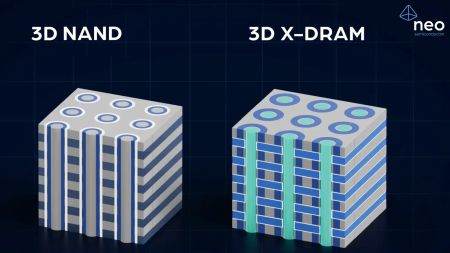
TSMC could soon develop its own 3D-DRAM chips and not just offer contract manufacturing.
The Taiwanese semiconductor manufacturer TSMC is reportedly planning to enter the 3D-DRAM business. This would represent a significant expansion of the company's portfolio, which has so far primarily focused on contract manufacturing of chips for other companies. The development of its own 3D-DRAM chips could place TSMC in a new competitive position in the memory chip market.
3D-DRAM, a technology that allows DRAM cells to be stacked vertically, promises higher memory densities and improved performance compared to conventional DRAM technologies. This innovation could be particularly significant for applications in Artificial Intelligence, cloud computing, and data processing, where large amounts of data need to be processed quickly.
TSMC's decision to develop its own 3D-DRAM chips may also be motivated by the increasing demand for high-performance memory solutions. Companies across various industries are looking for ways to optimize their systems and enhance efficiency. With this initiative, TSMC could respond to market needs while also increasing its market share in the memory segment.
Market Analysis and Competition
The market for memory chips has grown significantly in recent years, and the introduction of 3D-DRAM could help TSMC stand out from other manufacturers. Companies like Samsung and Micron currently dominate the DRAM market, and TSMC could be able to establish itself in this competitive environment by developing its own products. The ability to offer innovative memory solutions could give TSMC a crucial advantage.
The development of 3D-DRAM requires significant investments in research and development as well as in production capacities. TSMC has proven in the past that it is capable of successfully implementing new technologies, which raises expectations for the upcoming developments in the area of 3D-DRAM. Analysts are closely monitoring the company's progress to assess the impact on the market and the competitive landscape.
The introduction of 3D-DRAM could also have implications for pricing in the memory chip market. If TSMC is able to offer competitive prices for its new products, this could increase pressure on other manufacturers to adjust their prices or further develop their own technologies. This could lead to intensified competition that ultimately benefits end consumers.
TSMC has established itself as an innovation leader in the semiconductor industry in the past. The move into the area of 3D-DRAM could not only expand the company's product range but also strengthen its position as a key player in the global technology sector. The coming months will be crucial to see how TSMC implements its plans and what reactions the market shows in response.
The development of its own 3D-DRAM chips could also enable TSMC to form new partnerships and collaborations with other technology companies. These alliances could help accelerate the market introduction of the new products and expand TSMC's reach in the memory segment. The company's strategic direction will be of great importance in the coming years.
TSMC has already announced that it will make significant investments in the development of new technologies over the next few years. The introduction of 3D-DRAM could be part of this comprehensive strategy aimed at strengthening the company's innovative capacity and solidifying its market position.
Ähnliche Artikel

Lords of the Fallen 2: New Gameplay and Class Changes
The new gameplay of Lords of the Fallen 2 shows significant changes for mages and ranged fighters. The battles will be m...

30 Years of Command & Conquer: Red Alert
The cult classic Command & Conquer: Red Alert celebrates its 30th anniversary. A look at its history and influence....

LinkXpert SQ: New Tester for Ethernet Suitability
Softing IT Networks presents the LinkXpert SQ, a tester for qualifying cables for Ethernet data rates....

Apple brings touchscreens to the MacBook Pro
Apple has introduced new MacBook Pro models with touchscreens and OLED displays that can cost up to 16,000 euros....
comment Kommentare (0)
Noch keine Kommentare. Schreiben Sie den ersten!
Kommentar hinterlassen