
OpenAI develops AI to fix Linux security vulnerabilities
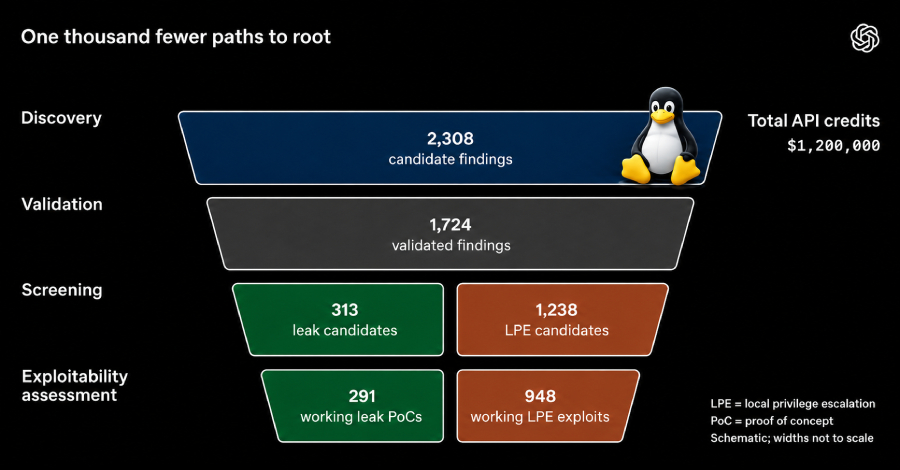
OpenAI has introduced an AI pipeline that has identified and fixed 948 security vulnerabilities in Linux.
OpenAI has introduced a novel pipeline on Wednesday that, using an upcoming AI model for cybersecurity, has identified and fixed 948 local privilege escalation vulnerabilities (LPE) in the Linux operating system. The cost of using this API amounted to 1.2 million dollars. This development could have far-reaching implications for the security of Linux-based systems that are deployed in many companies and organizations worldwide.
The OpenAI pipeline analyzed a total of 2,308 potential security vulnerabilities in the Linux kernel. Of these, 1,724 vulnerabilities were dynamically reproduced, demonstrating the efficiency and effectiveness of the AI-driven approach. The ability to identify and reproduce such a large number of vulnerabilities showcases the potential of AI in cybersecurity.
Technical Details of the AI Pipeline
The AI pipeline utilizes advanced algorithms to detect security vulnerabilities in the Linux kernel. Through machine learning and data analysis, the pipeline can not only identify existing vulnerabilities but also generate solutions to address these issues. This occurs in an automated process that minimizes the need for human intervention and increases the speed of security updates.
Identifying and fixing LPE vulnerabilities is particularly important, as such weaknesses allow attackers to gain higher privileges on a system. This can lead to serious security incidents that jeopardize the integrity and confidentiality of data. OpenAI's approach could significantly enhance the security of Linux distributions.
The cost of 1.2 million dollars for API usage reflects the complexity and resource demands associated with the development and operation of such AI-driven systems. OpenAI has emphasized that investing in this technology is necessary to counter the ever-growing threats in the field of cybersecurity.
Impact on the Cybersecurity Landscape
The introduction of this AI pipeline could revolutionize how companies identify and address security vulnerabilities in their systems. Traditionally, analyzing security gaps requires extensive manual reviews and testing, which can be time-consuming and error-prone. With automation through AI, companies can respond more quickly to new threats and better protect their systems.
The relevance of OpenAI's pipeline extends beyond the Linux kernel. The technologies and methods developed in this project could also be applied to other operating systems and software applications. This could lead to a more comprehensive improvement in cybersecurity across various domains, from corporate networks to cloud services.
OpenAI plans to further analyze the results of this initiative and continuously improve the pipeline. The organization has already announced that it will implement additional features and enhancements in the future to increase the efficiency and effectiveness of security solutions. Developments in this area are being closely monitored by experts, as they could potentially influence the entire industry.
The AI pipeline from OpenAI is a significant step towards a safer digital future. The ability to quickly identify and fix security vulnerabilities could help minimize risks for businesses and individuals. The technology is expected to be further refined and optimized in the coming months.
Ähnliche Artikel

Netflix tests AI-powered recommendations
Netflix introduces AI Discover, an AI feature for personalized streaming recommendations that responds to users' moods....

Hidden AI Debts of Tech Giants Rise Dramatically
The AI investments of major tech companies have led to a doubling of hidden debts. The financial situation is becoming i...

HPE sends Spaceborne Computer-4 to the Moon
Hewlett Packard Enterprise plans to deploy the Spaceborne Computer-4 on the Moon to test high-performance computing and ...
TD Synnex opens new AI lab for partners
The DACH AI Lab by TD Synnex provides partners access to AMD workstations for AI projects....
comment Kommentare (0)
Noch keine Kommentare. Schreiben Sie den ersten!
Kommentar hinterlassen